Zero Knowledge
Oct 2, 2025
A Comparison of zkVM DSLs: Halo2, Zirgen, and Plonky3
Deep dive into ZK constraint systems: Halo2's PLONKish circuits, Zirgen's STARK compiler, and Plonky3's direct AIR authoring. Complete with Fibonacci examples.
Zero Knowledge
Jun 24, 2025

Google: Anonymous Credentials from ECDSA
Core Idea Expanded
Cloudflare — Private Web Attestation with Zero-Knowledge Proofs
Enter Zero-Knowledge Proofs
How It Works
EZKL — Provable Machine Learning with ZKPs
Architecture Overview
TikTok — Trustless Attestation Verification
TikTok’s Trustless Attestation Verification
Acknowledgments
When most people hear about zero-knowledge proofs (ZKPs), they think of crypto wallets and blockchain rollups. But ZKPs are quietly powering a new class of privacy-first applications — in everything from AI to cloud infrastructure — far outside the Web3 bubble.
At their core, ZKPs allow one party to prove a statement is true without revealing why it's true. That sounds abstract — but in practice, it means you can prove your age without showing your ID, prove a machine learning result without revealing the input, or verify the security of a remote server without trusting the company that runs it.
In this article, we’ll explore how ZKPs are being used in real-world systems by major players like:
Each project shows a different face of what zero-knowledge can do — not just as a tool for financial anonymity, but as a fundamental building block for a more private, verifiable, and user-respecting internet.
Proving sensitive attributes (like “age ≥ 18”) can be a privacy minefield. Traditional approaches suffer from:
Google’s “Anonymous Credentials from ECDSA” addresses all of the above: it uses the ubiquitous ECDSA hardware interface for broad compatibility, yet delivers true anonymity and zero-knowledge.
When you ask Google Wallet to prove an attribute—say, “age ≥ 18”—it actually constructs a complex statement and then runs two layers of zero-knowledge proofs (sumcheck + Ligero) over that statement. Here’s how it breaks down:
MDOC Transcript Components
An MDOC (Mobile Driver’s License) proof produces a transcript containing:
sig_1): an ECDSA signature by the issuing authority (e.g. DMV) on a hash of the credential data.MDL["valueDigests"]["org.iso.18013.5.1"]["age_over_18"] = True
sig_2): an ECDSA signature by the device’s hardware key on the server’s challenge transcript, preventing replay.time_start and time_end, checked sotime_start < time_now < time_endSumcheck Prover
Non-Interactive Ligero Wrap
sig_1, sig_2, the nonce, or any other internal data.By composing sumcheck with Ligero (a technique borrowed from the latest ZK research), Google Wallet delivers hardware-level security, freshness, and true anonymity in a proof that your attribute (e.g. “age ≥ 18”) is valid—without ever leaking your ID, device key, or biometric data.
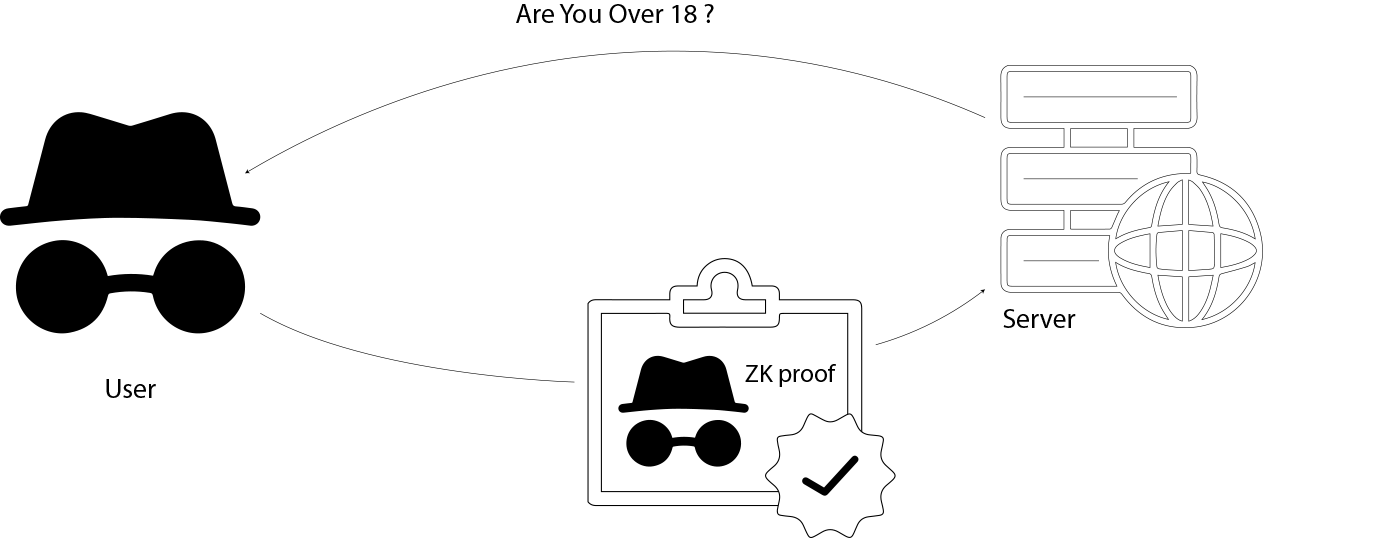
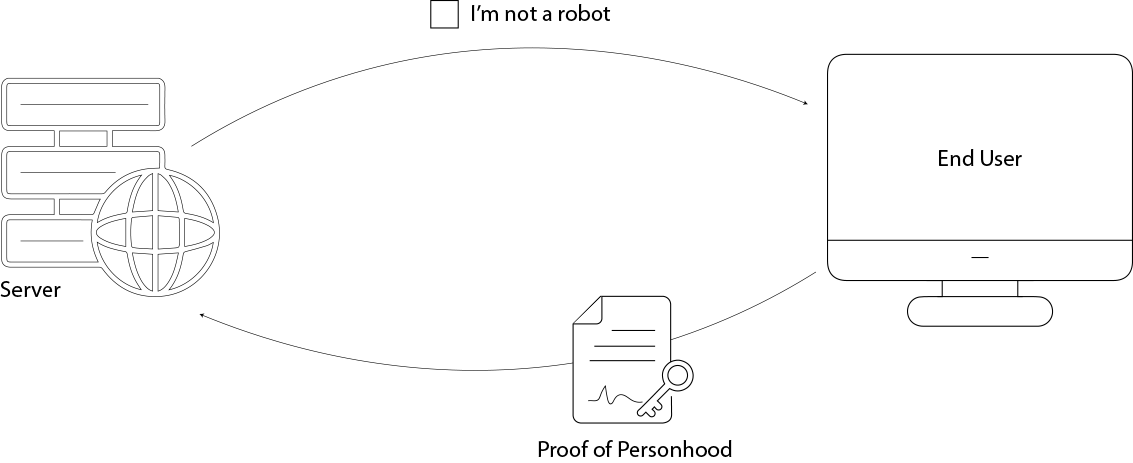
Cloudflare is reimagining how we prove we're real people on the internet — not with CAPTCHA puzzles or user accounts, but with hardware-backed proofs that respect privacy.
Traditionally, websites use WebAuthn attestation to verify a user's hardware key (like a YubiKey). This attestation proves the key is authentic and issued by a trusted manufacturer, using a digital signature and a certificate chain. But there’s a privacy catch: the attestation leaks metadata — like the key’s make and model — which can be combined with other browser signals to help fingerprint users.
Even though WebAuthn was designed with privacy policies in mind, Cloudflare wanted to go further. Their goal: verify that a user holds a trusted hardware key — without learning anything else about it.
All they really need is a binary answer: “Is this a real, uncompromised security key?” They don’t care who made it, what model it is, or how many others like it exist.
Cloudflare designed a custom zero-knowledge proof (ZKP) protocol to do exactly that.
Instead of sending the raw attestation signature (which reveals metadata), the browser constructs a ZKP that proves:
All of this is proven without revealing which key it was. The server learns nothing except: “Yes, a valid, trustworthy key signed this.”
In the protocol, we needed to express elliptic-curve operations as arithmetic constraints inside a zero-knowledge proof. Standard curves like P-256 are defined over a prime field whose group order is different from . That mismatch creates a major headache:
Group operations (point addition, scalar multiplication) happen modulo the group order . Field operations (add/mul of coordinates) happen modulo the prime .
In a ZK circuit, mixing two moduli means building separate constraint gadgets for modular reduction by and by , roughly doubling the complexity.
To avoid this, the team set out to engineer new curves (nicknamed Tom curves) such that the group order of the new curve matches the base field size of the original one. This makes it so that all the arithmetic happens in the same field
In practice, generating a Tom curve meant:
By reversing the usual design — fixing the order first, then finding the curve — the team unlocked a dramatically more efficient ZK-friendly elliptic curve that powers zkAttest’s high-performance proofs.
The Pedersen opening of is consistent with and .
verifies under the committed key.
verifies .
We need to prove a device’s ECDSA signature is valid without revealing its key. To do this:
Alternate ECDSA Check
Rewrite the usual verification
as the single relation
Commit & Prove
This zero‐knowledge proof confirms the signature is genuine, without ever exposing or .
To prove a committed public key is one of the “trusted keys” without revealing which one, zkAttest leverages a one-out-of-many ZK proof over Pedersen commitments. In essence:
By using the classic one-out-of-many proof system, zkAttest achieves private, efficient set-membership without exposing any extra information.
The final proof is the concatenation of and , made non-interactive via Fiat–Shamir. With zkAttest, Cloudflare achieves trustless, privacy-preserving attestation: the server learns only “this is a genuine, uncompromised security key” — and nothing more.
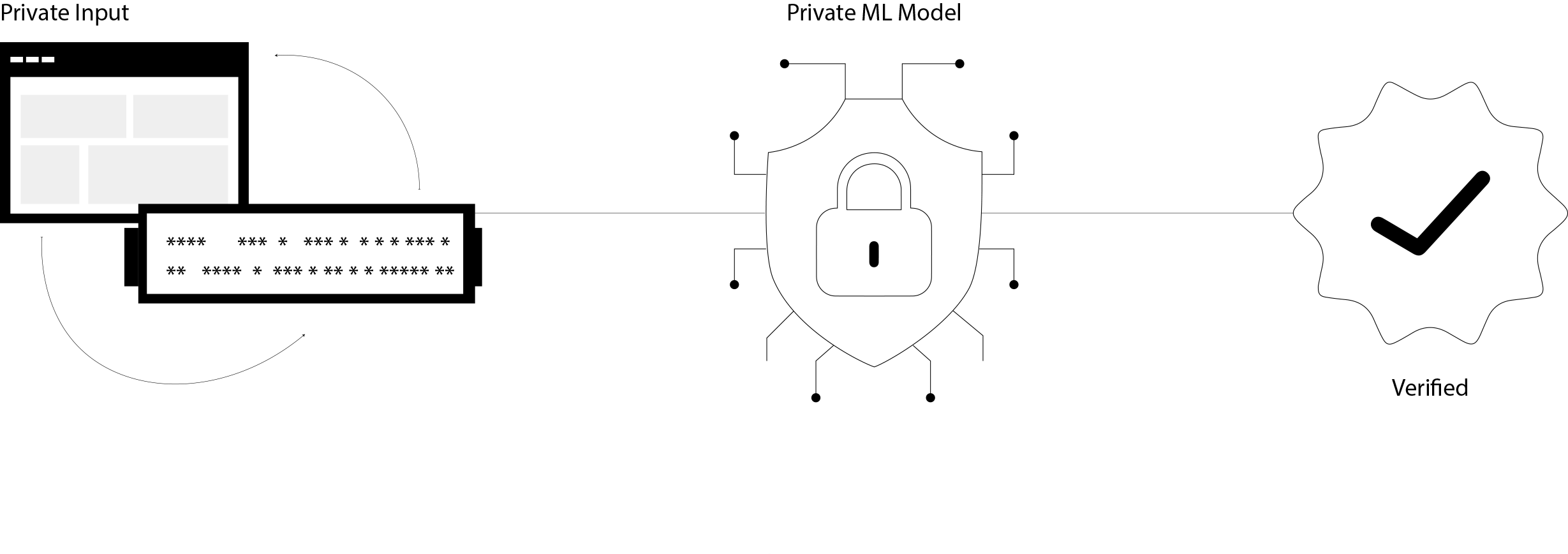
In many scenarios, we need to convince someone that a neural network inference was performed correctly—yet without exposing sensitive details. For example, you might want to prove that:
Each combination addresses a different privacy-versus-verifiability trade-off, but they all share the same core goal: “I executed a neural network and produced output from input under weights ”, without leaking secrets.
Achieving this requires overcoming several technical hurdles:
In the next section, we’ll see how EZKL’s compiler, optimizer, and Halo2-based proving backend work together to solve these challenges.
EZKL’s design breaks the zkML pipeline into four clear stages, each handling a key aspect of turning a neural network into a succinct zero-knowledge proof.
ezkl compile to build the circuit,ezkl prove to generate a proof for given inputs,ezkl verify to check the proof against public outputs.These components work together to transform a standard neural network inference into a privacy-preserving, easily verifiable proof, without requiring developers to become cryptography experts.
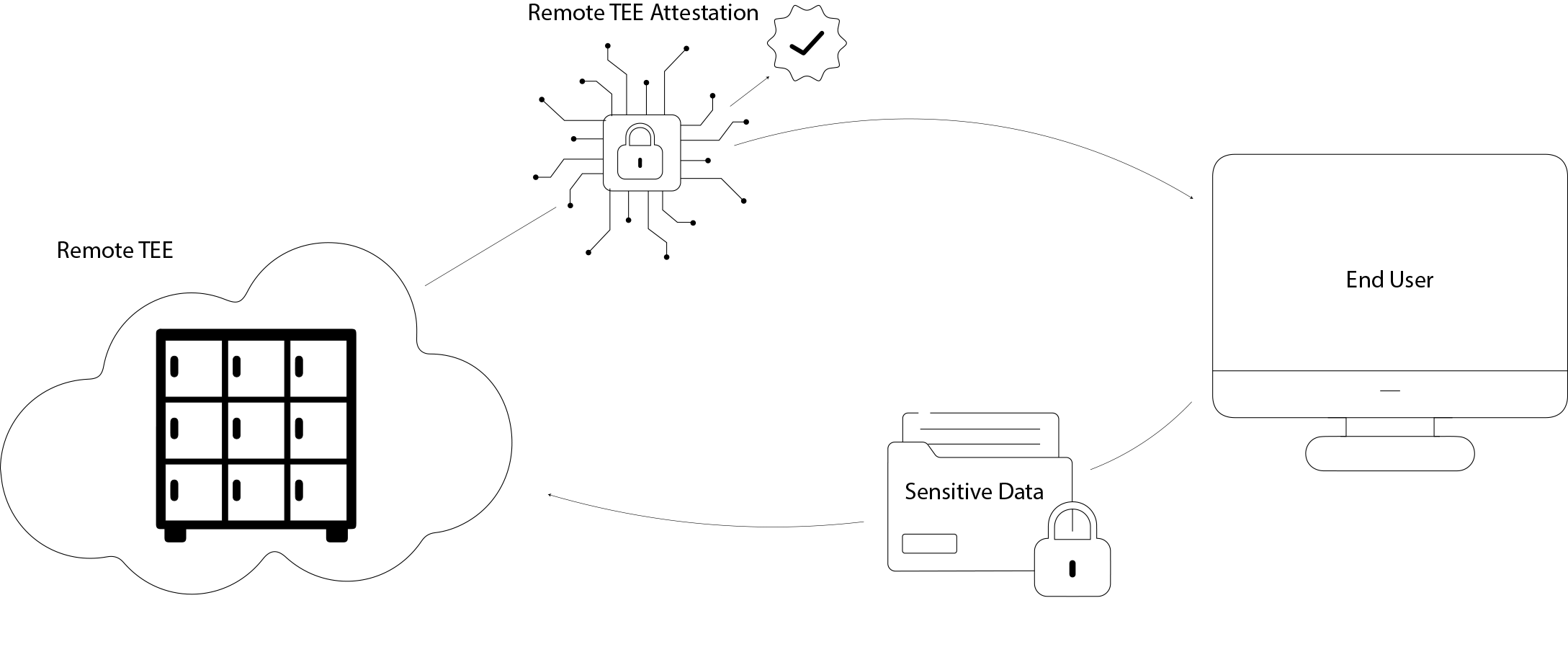
Trusted Execution Environments (TEEs) such as Intel SGX or AMD SEV create hardware-enforced “enclaves” where sensitive code and data are shielded—even from the cloud provider’s own OS. To ensure you’re talking to a genuine enclave, cloud providers offer Remote Attestation (RA) services: you send the enclave’s evidence (certificates, firmware hashes, PCR values), and the RA service verifies it against vendor roots and returns a simple “OK” or “Fail.”
Relying on an RA service shifts trust from just the CPU vendor to both the vendor and the cloud provider’s attestation logic.
We want to remove the need to trust the RA server itself. Instead of blindly accepting a yes/no response, the enclave (or another untrusted service) generates a zero-knowledge proof that directly shows:
With such a proof, any relying party can independently and securely verify enclave authenticity, reducing the trust boundary back to just the hardware vendor.
TikTok’s solution turns the traditional remote attestation process into a transparent, zero-knowledge proof, removing the need to trust a centralized attestation server. Here’s how it works at a high level:
Raw TEE Evidence as Input
The enclave produces its usual attestation evidence—certificate chains from the hardware vendor, firmware measurements, and PCR (Platform Configuration Register) values. This raw data is the input to the proof system, but never appears in the clear to the verifier.
Circom Circuit Encodes Verification Logic
TikTok implements the exact same verification steps you’d expect in a remote attestation service—checking each certificate’s signature against vendor root keys, comparing firmware hashes, and validating PCR registers—as a Circom arithmetic circuit. Every conditional and cryptographic check becomes a sequence of modular arithmetic constraints.
zkSNARK Proof Generation
Using a standard SNARK framework (e.g. Groth16 via snarkjs), the prover compiles the Circom circuit, runs a trusted setup, and then generates a succinct proof. This proof attests that “I ran the attestation verifier code on this evidence and every check passed,” without revealing any of the certificates, hashes, or PCR values themselves.
Public Verification
Any relying party—whether it’s a customer service backend, a blockchain smart contract, or another enclave—can load the public verification key and efficiently validate the SNARK proof. The result is a simple yes/no decision on enclave authenticity, with no hidden trust in a remote server.
By recasting remote attestation as a zero-knowledge proof over TEE evidence, TikTok’s approach restores trust to the hardware vendor alone. It bridges the gap between strong hardware guarantees and the need for minimal trust in software services, all while preserving the confidentiality of attestation data.
Below is a Circom template, validate_x509_rsa, which implements an end-to-end RSA-PSS signature check on a X.509 certificate.
template validate_x509_rsa(word, number_blocks, e_bits, hash_len, tbs_certificate_len) {
  // uint8_t modulus[512];
  signal input modulus[512];
  // uint8_t tbs_certificate[tbs_certificate_len];
  signal input tbs_certificate[tbs_certificate_len];
  // uint8_t signature[512];
  signal input signature[512];

  // constraining modulus and signature to byte values (0–255).
  component modulus_bytes[512];
  component signature_bytes[512];
  for (var i = 0; i < 512; i++) {
    modulus_bytes[i] = Num2Bits(8);
    signature_bytes[i] = Num2Bits(8);
    modulus_bytes[i].in <== modulus[i];
    signature_bytes[i].in <== signature[i];
  }

  // Modulus needs to be reversed (i.e., converted to little-endian).
  signal modulus_little_endian[512];
  component reverse_modulus = reverse_bytes(512);
  reverse_modulus.in <== modulus;
  modulus_little_endian <== reverse_modulus.out;

  // Signature needs to be reversed (i.e., converted to little-endian).
  signal signature_little_endian[512];
  component reverse_signature = reverse_bytes(512);
  reverse_signature.in <== signature;
  signature_little_endian <== reverse_signature.out;

  // Convert the modulus and signature into uint64_t arrays.
  component modulus_qwords = bytes_to_qword(512);
  component signature_qwords = bytes_to_qword(512);
  modulus_qwords.buf <== modulus;
  signature_qwords.buf <== signature_little_endian;

  // Compute the SHA384 hash of the content to be signed.
  // The whole TBSCertificate is hashed using the algorithm specified in the signature algorithm field.
  component sha384_hasher = Sha384_hash_bytes_digest(tbs_certificate_len);
  sha384_hasher.inp_bytes <== tbs_certificate;

  // Verify the signature.
  component rsa_verifier = RsaVerifySsaPss(word, number_blocks, e_bits, hash_len);
  // Value is valid.
  rsa_verifier.modulus           <== modulus_qwords.out;
  rsa_verifier.sign              <== signature_qwords.out;
  rsa_verifier.message_hashed    <== sha384_hasher.hash_bytes;
}
This article drew on the pioneering work of several teams and projects: